

Curate: know whether your data is good enough.
Curate is the data-quality stage of Videre. It turns a drive full of recordings into a qualified, living good-data set — so you know whether to analyze what you have or go back and collect more, instead of guessing while the clock runs.
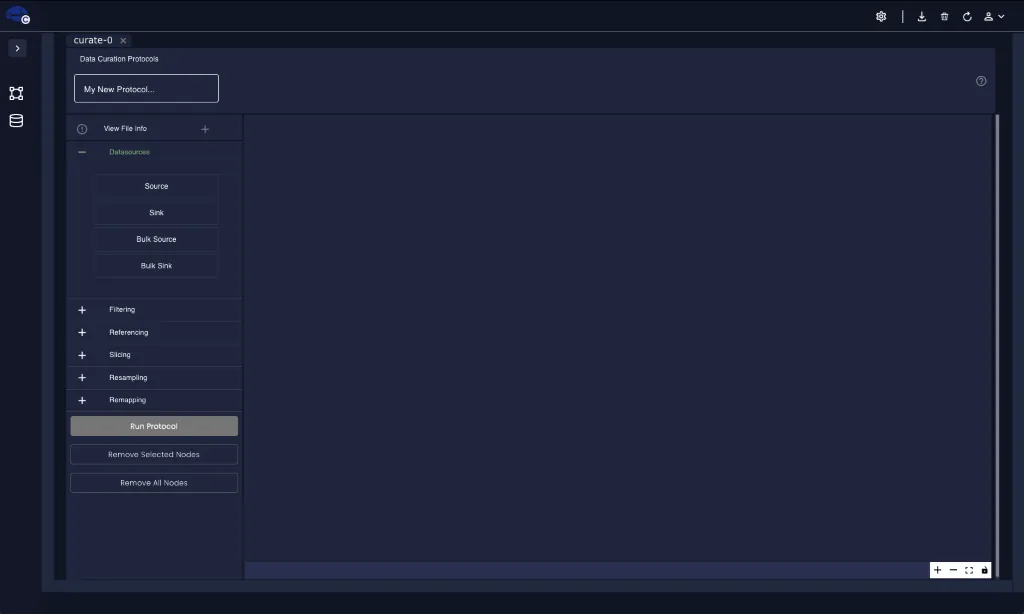
From a pile of recordings to a dataset you can stand behind.
The hardest question after a run of experiments isn't your hypothesis — it's whether the data is good enough to answer it. Curate answers that question with numbers, not hope, and builds the result into a dataset you keep.
Know, don’t guess
Quality is computed and shown across every channel and recording — so you can tell good data from bad.
Focus where it counts
Find the segments — in time and across channels — that are clean and during the conditions you care about.
A living dataset
Aggregate the recordings that qualify into a study set you can add to or trim as the work evolves.
Verifiable
Every dataset carries its provenance and exports to open standards — so the result holds up beyond your lab.
The enemy is not knowing.
After a stretch of recordings, you have a drive full of files and one question that decides your next month: is this good enough to analyze, or do I need to collect more? Guess "good" and you can sink weeks into data that was never going to answer the question; guess "collect more" and you burn animals, time, and per-diems you did not need to. The real killer is not either wrong turn — it is not being able to tell, and paying for the uncertainty in wasted effort and stress. Curate exists to end that: it replaces the guess with computed quality, and turns the recordings that qualify into a good-data set you can rely on and verify.
You can’t see quality — you compute it.
In stochastic signals, quality hides in the statistics and the first-order transforms, not the raw trace.You cannot eyeball whether a recording is good; the signal is stochastic, and its quality shows up only when you measure it — per-channel statistics, and the first pass of analysis. This is the kind of rigorous, standardized quality assessment the field is moving toward — RIGOR-inspired, after the IBL’s Recording Inclusion Guidelines for Optimizing Reproducibility (eLife, 2025). Radiens computes the underlying quality metrics that judgment rests on today; automatic RIGOR-inspired gates are on the roadmap.
See quality on every channel
Signal quality is computed and shown across every recording — numbers, not eyeballing.
Know a file is complete
An integrity check flags gaps before you build anything on it.
Quality shows up in the sort
Read cluster-quality metrics from the standard sorter — in spikes, quality lives in the sort.
Good data is an intersection.
Clean channels, clean time, and the conditions you actually care about — all at once.A recording is not simply good or bad. The data you can use is the intersection: the channels with clean signal, during the time windows without artifact, that fall in the experimental conditions of interest. A beautiful response during the no-stimulus window, or off your target, does not help — so Curate lets you find and keep the segments where all three line up.
Rank and act on channels
Sort channels by quality, exclude the bad sites, and focus on the best.
Cut the bad epochs — non-destructively
Exclude artifact windows as metadata; the raw recording is never touched.
Line it up with your conditions
Keep the segments that are clean and during the epochs you care about.
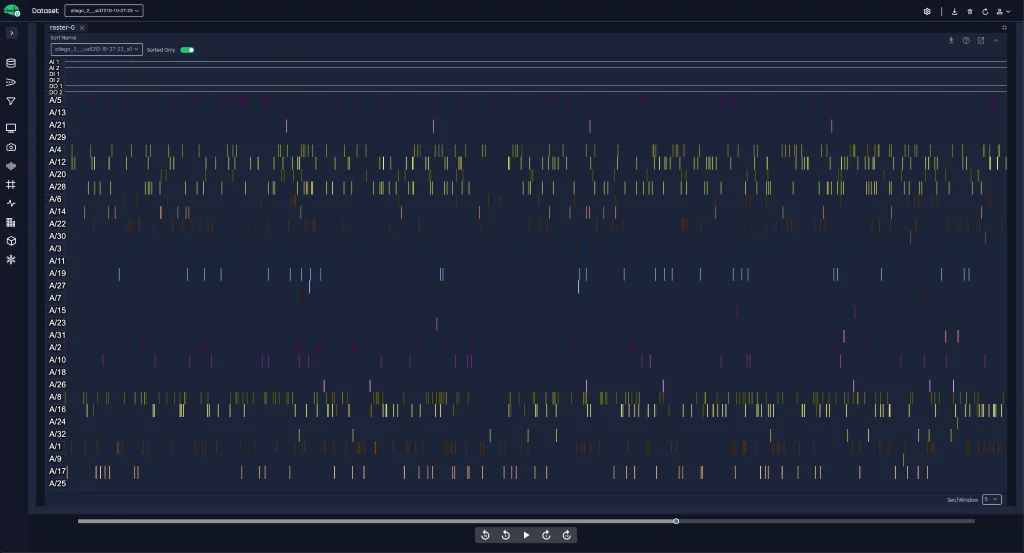
Build the good-data set.
Aggregate the recordings that qualify into a living study set — add what fits, drop what doesn’t.The recordings that pass become something you keep: a good-data set that is the real product of your bench work. Group the qualifying sessions into a study set, characterize it as a whole, and keep it living — open it to add data with the characteristics you need, or trim what turns out not to matter, as the science evolves.
Group into a study set
Organize qualifying recordings into collections, with metadata preserved throughout.
Characterize the whole set
Aggregate quality across the study and track how it drifts — judge the set, not one file.
Living — include and exclude as it evolves
Add what fits, drop what doesn’t; every decision is recorded, not lost.

Decide — and make it verifiable.
Once you know the set is good, the decision has to hold up — to a collaborator, a reviewer, or your future self. In Radiens the good-data set carries its own record: the original recordings are never overwritten, every transform is tracked, and the whole set exports to open standards so it travels without losing its context.
- ✓Non-destructive by design — the original recording is never overwritten; the transform chain is the record.
- ✓Every dataset carries its provenance — a unique ID and versioned transforms, so any result re-derives itself.
- ✓Exports to open standards — NWB, portable and FAIR-shareable.
What each tier unlocks.
Where this is going.
Everything above ships today. Two in-development capabilities extend quality from one dataset to the whole archive.
Automatic quality gates
Automatic RIGOR-inspired gates for noise floor, line noise, saturation, drift, channel correlation, and the 1/f exponent — quality assessed as a funnel, not by hand.
Quality summaries & triage
Score and triage whole data archives — know which recordings are worth opening before you open them.
A good-data set is where analysis should start.
Curate is the step that makes the rest worth doing: analysis you can trust begins with data you have qualified. Take the good-data set into Videre for the deep work — or see how quality starts back at the rig, in Allego.
Frequently asked questions
How do I know if an electrophysiology recording is good enough to analyze?
You compute it rather than eyeball it. Radiens produces a per-dataset signal-quality report — SNR, noise floor, and impedance across every channel, 20+ metrics — plus a recording-integrity check and cluster-quality metrics from spike sorting, so you can triage and rank recordings before analysis instead of guessing from the raw trace.
What are the RIGOR criteria for recording quality?
RIGOR — Recording Inclusion Guidelines for Optimizing Reproducibility — is a set of recording-quality criteria from the International Brain Laboratory’s 10-lab Neuropixels reproducibility study (eLife, 2025), used to decide which channels and recordings to include. Radiens computes its own per-dataset quality metrics today, and RIGOR-inspired automatic gates are on the roadmap.
How do I build a curated dataset from many recordings?
Group qualifying recordings into a study set, characterize it with aggregate session- and study-level quality metrics, and keep it living — including the recordings that fit and excluding the ones that don’t as the work evolves. Every include and exclude decision is recorded, and the set exports to the open NWB standard.
Does curating my data in Radiens change the raw recording?
No. Curation is non-destructive: the original recording is never overwritten. Every transform — filtering, resampling, re-referencing, artifact rejection — is tracked as metadata, so the transform chain is a record you can inspect and re-derive, and the primary data stays intact.
Is data curation free in Radiens?
The signal-quality report and integrity check, dataset browse and management, non-destructive transforms with provenance, and NWB export are free in the Standard tier; Pro adds aggregate session- and study-level metrics, signal-metric actions, manual curation, and FAIR enrichment.
Stop guessing whether your data is good. Start free.
Compute the quality, keep the recordings that qualify, and build a good-data set you can rely on — on your own storage, with the provenance kept for you.