Videre: analysis you can verify — and hand to any tool.
Videre is the analysis app of Radiens. It does the standard analyses every lab needs — spike sorting, LFP, and spectral — and shapes, verifies, and provenance-stamps your data so you can rely on it, hand it to any tool (Python, open standards, agents), and verify the result.

Your work, with Radiens in it.
Today the work fights you: glue scripts between tools, uncertain data quality, and results that are hard to reproduce or trust. With Radiens in the loop, you see quality across the whole archive, run the standard analyses reproducibly, and hand off a verified, well-structured dataset that any tool — or any AI — can trust.
Easier
One environment from raw file to figure — no glue scripts between tools, no import step.
Verifiable
See quality across every recording and know the data is right — before you, or an AI, analyze it.
Reproducible
Every result carries a unique ID and provenance, so it re-derives itself — automatically.
Ready for any tool
Verified, well-structured, and portable — hand it to Python, open standards, or an agent, and never fall behind the frontier.
AI will run any analysis you ask. It won't tell you the data was wrong.
AI and open-source packages now put powerful analysis in every hand, which moves the bottleneck: it is no longer running the method, it is trusting what you fed it. Garbage in, garbage out — now at machine speed, because a confident result built on the wrong epochs or an uncurated channel looks exactly like a correct one. And no single program will ever hold every method; the frontier moves too fast. So the question that decides whether the science holds is not which analysis you run, but whether the data going in is the right data, correctly shaped, and provable. That is the layer Videre owns: the standard analyses every lab needs, done reproducibly, and a verified, hand-off-ready dataset that a person — or an agent — can trust.
Can you verify it — before you (or an AI) analyze it?
See quality across one recording or a whole archive, before anything touches it.The first question is not your hypothesis — it is whether the data is even good enough to trust. Radiens scores and ranks recordings up front and flags incomplete files, so your attention, and every tool downstream, starts from data you can rely on.
See quality on every channel, every recording
Signal quality is in view before you — or an AI — touch the data.
Know a file is complete
An integrity check flags gaps, so you build only on data you can trust.
The standard analyses every lab needs — done right, reproducibly.
Spike sorting, fields and spectral, and the spatial/temporal structure — the foundation, standardized and consistent.Videre does the analyses everyone reaches for — not a warehouse of methods you will never run, but the shared foundation, done the same way every time. Sort spikes, quantify fields, and make the when-and-where clear, even when the spatial arrangement was not known going in.
Spike sorting with quality metrics
Automated by default; probe-specific and hand-curated when the result needs it.
Fields and spectral analysis
LFP power, spectra, and the demanding field methods.
Structure made clear
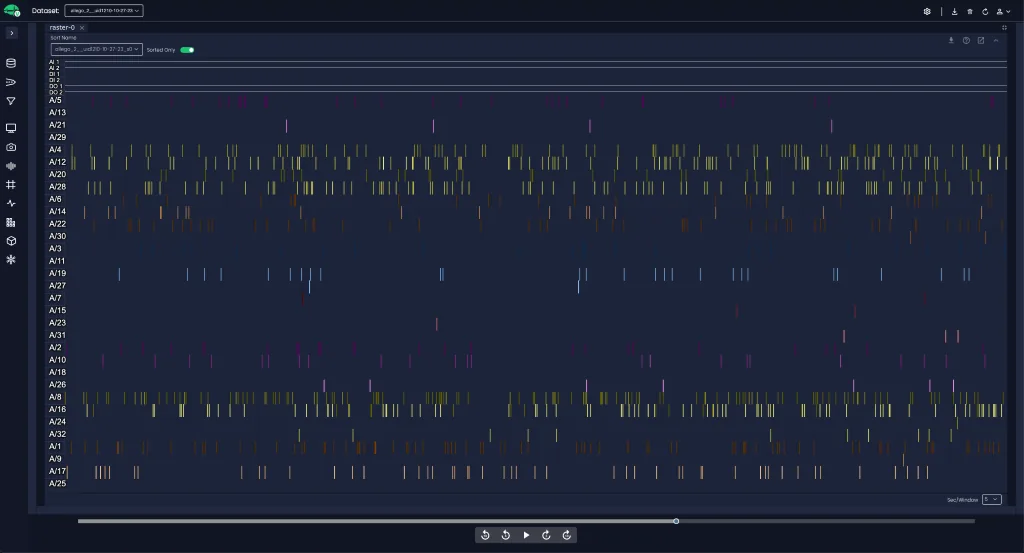
Your signal on the probe and in the brain, with rasters and event-locked views.
Hand it off to any tool — and ride the frontier.
No one tool has every method — and you shouldn't pay for a hundred you'll never run.Modern analysis rides Python, open-source packages, and now agents — a frontier that moves faster than any suite can ship. So Videre does not try to be the warehouse; it gets your data into and out of the right tool cleanly, with quality and provenance traveling along, so what you hand off is trustworthy and you never fall behind.
Read anything — no import step
Open any major vendor’s files, and EEG/ECoG, as interactive views — no conversion.
Out to open standards
Export to NWB — portable, archive-ready, and FAIR-shareable.
Drive it from Python or an agent
RadiensPy for full parity in Python; the agent-operable CLI for pipelines and agents.

Correctness you can prove — and keep.
A result has to hold up, and stay yours. In Radiens, quality and provenance travel with the data from the first sample: every dataset carries a unique ID and a versioned record of its transforms, every sort carries a settable RNG, and the whole thing re-derives itself months later — when a reviewer asks, or you revisit the work. And it never leaves your own storage.
- ✓Every result comes with a receipt — a unique ID and a provenance record of its transforms.
- ✓Re-derives itself — versioned transforms re-run to the same answer, years later.
- ✓Local-first, and yours — work against your own storage; nothing uploaded.
What each tier unlocks.
Where this is going.
The shipping analysis capabilities are the foundation. The frontier moves from analytics toward understanding the neural system itself.
Model-based interpretive analysis
Fit generative and statistical models to neural activity for higher-level inference — probe- and region-specific, moving from analytics toward interpretation.
Field-event detection
Automated sharp-wave ripples, spindles, oscillatory bursts, and phase-amplitude coupling — the events that matter, found for you.
See it well live — then see it deeply.
The deep analysis all of this earns starts at the rig: everything here builds on data you could trust when you recorded it. Acquire is the live half of the same act of seeing.
Videre — FAQ
Does Videre do every analysis, or replace Python and open-source tools?
No — and by design. No single program holds every method, and the frontier (Python, open-source packages, agents) moves faster than any suite can ship. Videre does the standard analyses every lab needs — spike sorting, LFP, spectral, quality — reproducibly, then shapes and verifies your data so you can hand it to any tool and trust the result. You don't pay for a hundred methods you'll never run.
How do I move Radiens data to and from Python or open-source tools?
Videre reads and writes NWB, the open standard (free), so your data is portable to and from any NWB-aware tool; RadiensPy gives a professional-grade Python client with full desktop parity (free); and the Radiens CLI returns structured JSON/markdown that composes cleanly with pipelines and AI agents (Pro). Files from Intan, SpikeGLX, Open Ephys, TDT, Plexon, NWB, and EEG/ECoG formats open with no conversion step.
What is Videre?
Videre is the analysis app of Radiens — it spike-sorts, computes LFP and spectral metrics, and curates recordings from any vendor's data in one environment, with no conversion step, and exports to open standards so results stay portable.
How do I spike-sort any vendor's data in Radiens?
Videre runs automated spike detection and clustering directly on Intan, SpikeGLX, Open Ephys, TDT, Plexon, and NeuroNexus files with no format conversion; the standard-model sorter is free in Standard, and Pro adds probe-specific models and manual split/merge/refine curation.
How does Videre keep an analysis reproducible?
Every dataset carries a unique ID and a provenance record of its transforms, and every sort carries a settable RNG, so any result re-derives itself exactly — the record of how a result was made travels with the data, which is what lets a downstream tool, collaborator, or AI trust it.
Is analysis in Radiens free?
Yes — the free Standard tier includes viewers, automated (standard-model) spike sorting, LFP and spectral analysis, signal-quality metrics, NWB export, and the RadiensPy Python client; Pro adds probe-specific sorting, manual curation, advanced fields analysis, the 3D brain atlas, FAIR enrichment, journal-ready export, and the agent-operable CLI. On-demand cluster-scale sorting is in development for Radiens Compute, the separate compute engine.
Verify the data; the result holds up — in one environment.
You run the analysis; Radiens carries the quality and provenance and gets your data to any tool, on your own storage. The result stays yours.